SEO vs Google Ads vs Social Media Marketing: Which Digital Marketing Strategy Does Your Business Need?
T
The CADD Studio
The CADD Studio
What Is SEO?
SEO stands for Search Engine Optimization. It is the process of improving a website so that it can appear more prominently in organic search results for relevant queries. For example, imagine you own an interior design company in Mumbai. Potential customers may search for terms such as "interior designer in Mumbai," "2 BHK interior design Mumbai" or "home interior design company Mumbai." An SEO strategy aims to help your website become more visible when people search for services related to your business. SEO can involve technical optimization, keyword research, content creation, on-page optimization, internal linking, website performance, local SEO and other activities. Unlike paid advertising, organic search results are not purchased on a per-click basis.
What Is Google Ads?
Google Ads is Google's advertising platform that allows businesses to display paid advertisements across Google's advertising network. One of the most common forms is search advertising, where businesses can bid to show advertisements when users search for particular keywords. For example, a person searching for "website development company Mumbai" may see paid advertisements from companies offering website development services. Google Ads can also include display advertising, YouTube advertising, shopping campaigns, remarketing and other campaign types depending on the business and objectives. For businesses that want immediate visibility for relevant searches, Google Ads can be a useful part of a digital marketing strategy.
What Is Social Media Marketing?
Social media marketing involves using platforms such as Instagram, Facebook, LinkedIn and other social networks to communicate with audiences and promote a business. Unlike search engines, where users often actively search for a product or service, social media can introduce people to businesses and products while they are browsing content. Social media marketing can include organic content, paid advertising, video content, educational posts, brand communication, community engagement and influencer or creator collaborations. For visually driven businesses such as interior design, architecture, real estate, fashion, food and lifestyle brands, social media can be particularly useful for showcasing work.
SEO vs Google Ads vs Social Media Marketing
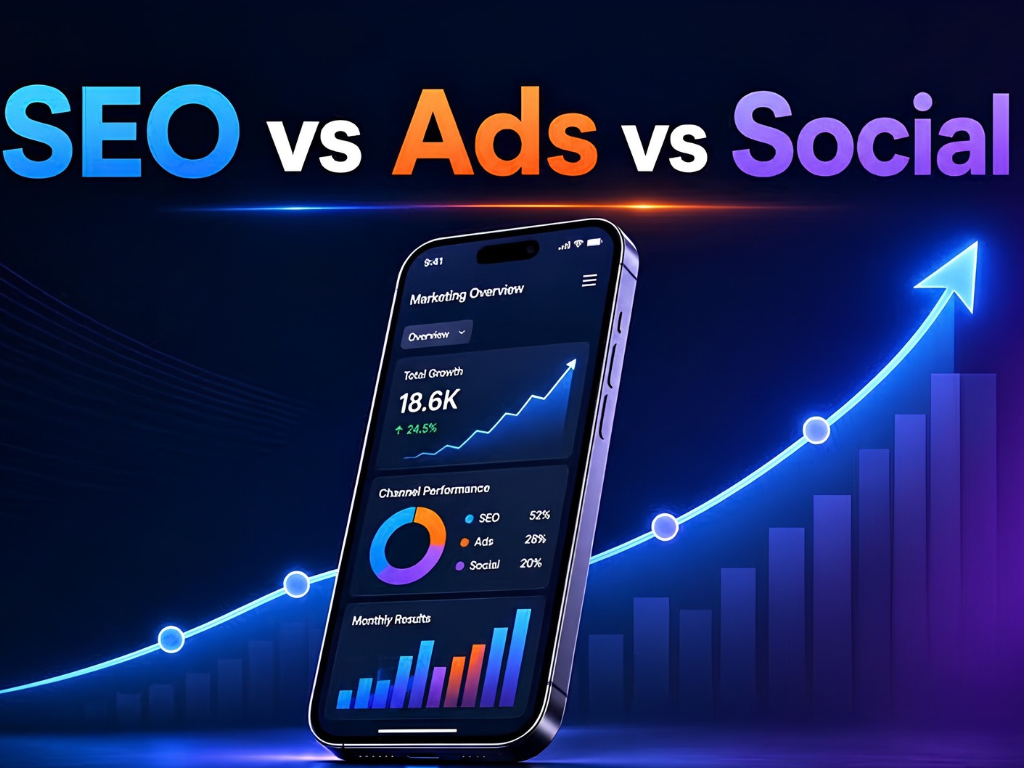
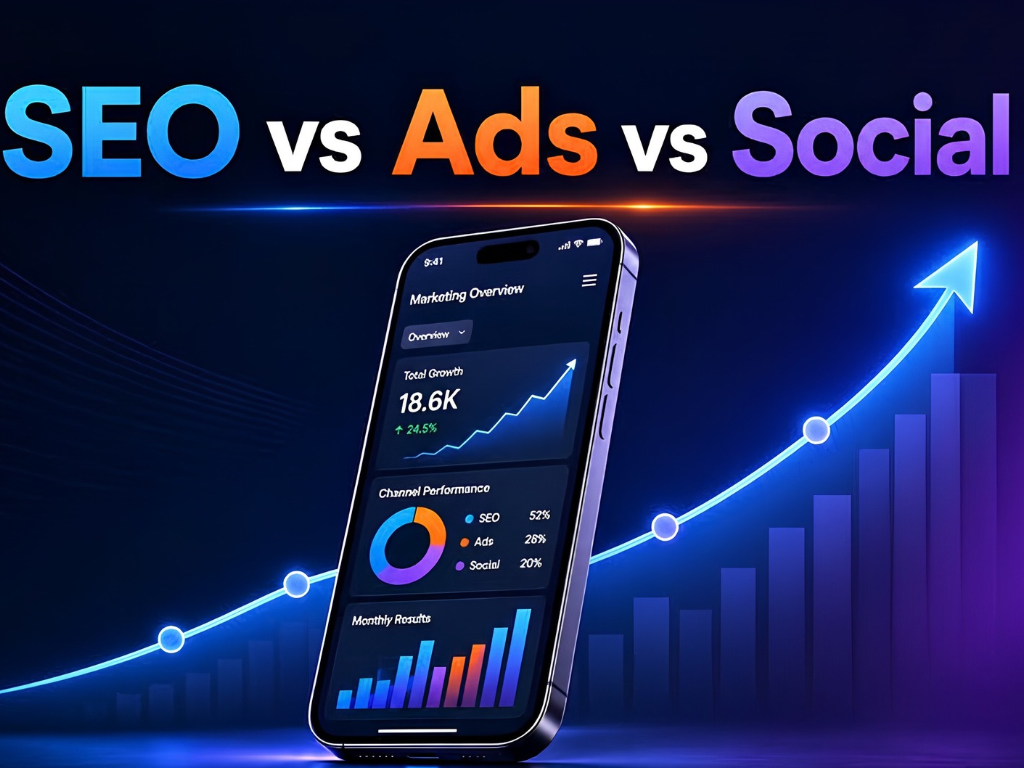
The biggest difference between these three strategies is the way they reach potential customers. SEO primarily captures existing search demand through organic search results. Google Ads can capture existing search demand through paid search visibility and can also reach users across Google's advertising ecosystem. Social media marketing can create awareness and demand by placing content or advertisements in front of relevant audiences. This means that the three channels can complement one another rather than necessarily competing with one another.
SEO: When Is It Useful?
SEO can be particularly useful for businesses that want to build long-term organic visibility. Suppose a business provides architectural design services. Potential customers may search for terms such as "architectural design company Mumbai," "architectural drawings," "floor plan design" or other related queries. If the company's website consistently produces useful content and has strong service pages, it can potentially build organic visibility for these searches over time. SEO can therefore become an ongoing source of relevant website traffic.
Advantages of SEO
One of the major advantages of SEO is that organic traffic does not work on the same pay-per-click model as search advertising. A well-performing page can continue attracting organic visitors after it has been published, although maintaining rankings requires ongoing effort. SEO can also help businesses build authority around their services. For example, a company providing BIM services can publish detailed resources about BIM, Revit, BIM coordination, clash detection and related topics. Over time, this can help establish topical relevance around the subject. SEO can also support local visibility for businesses targeting specific locations.
Limitations of SEO
SEO generally requires patience. A new website may take time to establish authority and visibility, particularly when competing against websites that have been publishing content and earning links for years. There is also no guarantee that every keyword will achieve a particular ranking position. SEO requires continuous monitoring and improvement because competitors, search behaviour and search engine systems change over time. For businesses that need immediate traffic, SEO alone may not always be sufficient.
Google Ads: When Is It Useful?
Google Ads can be useful when a business wants to reach people who are actively searching for relevant products or services. For example, someone searching for "SEO company Mumbai" is potentially demonstrating a stronger commercial intent than someone reading a general article about what SEO means. A business can use Google Ads to appear for relevant searches without waiting for organic rankings to develop. This can make paid search useful for new businesses, new websites, seasonal promotions and businesses operating in competitive markets.
Advantages of Google Ads
One of the biggest advantages of Google Ads is speed. Once campaigns are properly configured and approved, advertisements can begin receiving impressions and clicks relatively quickly. Google Ads also provides considerable control over targeting, budgets, keywords, locations, audiences and campaign settings. Businesses can measure metrics such as impressions, clicks, advertising costs, conversions and cost per conversion. This allows campaigns to be adjusted based on performance.
Limitations of Google Ads
Google Ads requires an advertising budget. When you stop paying for advertisements, the paid traffic generated through those campaigns generally stops as well. Performance can also vary significantly depending on competition and keyword costs. Highly competitive commercial keywords can have substantial costs, which means businesses need to manage campaigns carefully. Poorly structured campaigns can also waste budget through irrelevant searches, weak advertisements or landing pages that do not convert visitors effectively.
Social Media Marketing: When Is It Useful?
Social media marketing can be particularly useful for businesses that need to build brand awareness, demonstrate their work or engage with potential customers. Consider an interior design company. A completed living room, kitchen or bedroom can be visually presented through Instagram Reels, images, carousels and videos. Similarly, an architecture company can showcase 3D visualizations, floor plans and completed projects. A digital marketing company can share case studies, educational content and marketing insights. Social media allows businesses to demonstrate their expertise and personality while reaching potential customers.
Advantages of Social Media Marketing
Social media provides businesses with a direct way to communicate with their audience. It can support brand awareness, audience engagement, content distribution and community building. Visual content can be particularly effective on platforms such as Instagram. Social media advertising also provides audience targeting options that can help businesses reach users based on available demographic, interest, behavioural and other targeting signals. For brands with strong visual or educational content, social media can become an important part of their overall marketing strategy.
Limitations of Social Media Marketing
Social media algorithms determine how organic content is distributed, which means that publishing content does not guarantee that every follower will see it. Building a strong social media presence can also require consistent content creation. Businesses may need to invest in photography, graphic design, video production, copywriting and community management. Social media can also generate awareness without necessarily producing immediate sales, particularly when the customer has a longer buying journey.
SEO vs Google Ads: What's the Difference?
SEO and Google Ads can both help businesses appear when people search on Google, but they operate differently. SEO focuses on organic search results, while Google Ads places paid advertisements in eligible advertising placements. SEO generally requires time to build visibility, while Google Ads can provide paid visibility much faster. SEO can support long-term organic traffic, while Google Ads provides traffic based on advertising spend and campaign performance. This means that many businesses can benefit from using both. Google Ads can help capture demand while SEO works toward building sustainable organic visibility.
SEO vs Social Media Marketing
SEO and social media marketing reach audiences differently. SEO primarily reaches people when they search for information, products or services. Social media can reach people while they are browsing content, discovering brands or engaging with communities. For example, someone searching for "3 BHK interior design Mumbai" is already expressing a specific interest. Someone watching a video showcasing a beautifully designed 3 BHK apartment on Instagram may not have been actively searching for an interior designer but could become interested after seeing the project. This is one reason why search and social can work well together.
Google Ads vs Social Media Ads
Google Ads and social media advertising can also serve different purposes. Search advertising can reach people based on what they are actively searching for. Social media advertising can reach audiences based on available audience targeting signals and the content they engage with. For a service business, Google Search Ads can be useful when people are already looking for the service. Social media advertising can be useful for introducing the brand to relevant audiences and creating awareness. The appropriate channel depends on the business model and campaign objective.
Which Digital Marketing Strategy Is Best for a New Business?
A new business often needs both visibility and credibility. SEO can help build the company's organic presence over time, while Google Ads can provide paid visibility while the website and organic rankings develop. Social media can help introduce the brand, showcase its work and build an audience. For example, a new interior design company could develop SEO content around interior design costs and apartment interiors, run Google Ads for high-intent local searches and use Instagram to showcase completed designs. This creates multiple opportunities for potential customers to discover the company.
Which Strategy Is Best for Local Businesses?
Local businesses can benefit from combining SEO, Google Ads and social media depending on their objectives. Local SEO can help businesses appear for relevant location-based searches. Google Ads can provide paid visibility for commercial searches. Social media can help showcase products, services, projects, offers and customer experiences. A Mumbai-based business, for example, may want to optimize its website for searches containing Mumbai and relevant neighbourhoods while also using paid campaigns and social content to reach potential customers.
Which Strategy Is Best for Lead Generation?
Lead generation depends heavily on the type of business and how customers make purchasing decisions. Google Ads can be effective when people are actively searching for a service. SEO can generate leads through organic search over time. Social media can generate leads through organic content, paid campaigns, direct messages and lead-generation features depending on the platform. A strong lead-generation strategy should therefore focus not just on traffic but on what happens after someone reaches the website. The landing page, offer, trust signals, enquiry form, call-to-action and conversion tracking all matter.
Why Your Website Matters Across All Three Channels
Your website is often the destination for traffic generated by SEO, Google Ads and social media. This means that digital marketing cannot be separated completely from website development. A website should communicate the business clearly and make it easy for visitors to understand the services, evaluate the company and take action. For SEO, the website needs appropriate content and technical foundations. For Google Ads, landing pages should be relevant to the advertisement and search query. For social media, the website should provide a clear destination for users who want more information about the business. A poorly designed or poorly optimized website can reduce the effectiveness of all three marketing channels.
What Is a Full-Funnel Digital Marketing Strategy?
A full-funnel approach considers customers at different stages of their buying journey. At the awareness stage, social media and informational content can introduce people to a brand. At the consideration stage, SEO content, case studies, service pages and educational resources can help people evaluate their options. At the conversion stage, Google Ads, high-intent SEO pages and optimized landing pages can help capture users who are ready to enquire or purchase. The exact funnel differs from business to business, but the principle remains the same: different channels can support different stages of the customer journey.
How Much Should a Business Spend on Digital Marketing?
There is no universal digital marketing budget that applies to every business. The appropriate investment depends on the industry, competition, geographical market, customer value, sales cycle and business objectives. Businesses should consider both marketing spend and the resources required to create content, manage campaigns, maintain the website and analyze results. For paid advertising, the media budget should be considered separately from the agency or management fee where applicable. The important question is not simply how much to spend, but whether the marketing investment can be measured against meaningful business outcomes.
How to Decide Between SEO, Google Ads and Social Media Marketing
Start by identifying how your customers discover businesses like yours. If customers frequently search Google for your products or services, SEO and Google Ads may be important channels. If your product or service is highly visual, social media may play a larger role. If customers have a long research process, SEO content and educational resources can help them evaluate your business. If you need immediate visibility for high-intent searches, Google Ads may be useful. In many cases, the most effective strategy is not choosing one channel but creating a coordinated strategy across multiple channels.
Why Tracking and Analytics Matter
Digital marketing decisions should be based on data rather than assumptions. Businesses should track meaningful actions such as form submissions, calls, purchases, bookings or other agreed conversions. For SEO, businesses can monitor organic impressions, clicks, landing pages and conversions. For Google Ads, businesses can evaluate clicks, costs, conversions and cost per conversion. For social media, metrics such as reach, engagement, audience growth and campaign conversions may be relevant depending on the objective. Tracking allows businesses to identify what is working and where improvements are needed.
Common Digital Marketing Mistakes Businesses Should Avoid
One common mistake is trying to use every digital marketing channel without a clear strategy. Another is focusing entirely on vanity metrics such as followers, likes or website traffic without connecting them to business objectives. Some businesses also start Google Ads without proper conversion tracking. Others publish large amounts of SEO content without understanding search intent. Another common problem is sending every advertising campaign to the same homepage instead of creating relevant landing pages. Digital marketing becomes more effective when each activity has a clear purpose and measurable objective.
Why Choose The CADD Studio for Digital Marketing?
The CADD Studio provides a range of digital marketing and website development services designed to help businesses establish and grow their online presence. Our services include SEO, Google Ads, Meta Ads, social media marketing, website development, content strategy and digital marketing solutions. We understand that SEO, paid advertising, social media and website development should not operate as completely separate activities. A website should provide the foundation for digital marketing, while SEO can build organic visibility, Google Ads can capture relevant paid search demand and social media can support awareness and engagement. Our approach is based on understanding the business, target audience, competition and desired outcomes before determining the appropriate digital marketing strategy.
Frequently Asked Questions
Is SEO better than Google Ads?
SEO and Google Ads serve different purposes. SEO focuses on organic visibility and generally requires time to build, while Google Ads provides paid visibility based on advertising campaigns. Many businesses use both.
Is Google Ads better than social media marketing?
Neither is universally better. Google Ads can be useful for reaching people actively searching for relevant products or services, while social media marketing can help build awareness, engagement and demand among relevant audiences.
Should a new business invest in SEO?
SEO can be valuable for a new business, particularly if customers use search engines to find its products or services. However, SEO usually requires time, consistent content and ongoing optimization.
Should I run Google Ads and SEO together?
They can complement each other. Google Ads can provide paid search visibility while SEO works toward building organic visibility. Using both can also provide data about search terms and user behaviour that can inform broader marketing decisions.
How long does SEO take to work?
There is no fixed timeframe. Results depend on factors such as website age, competition, content quality, technical SEO, authority and target keywords. New websites may require time to establish organic visibility.
Is social media marketing important for small businesses?
It can be, particularly when the target audience is active on relevant platforms or when the business benefits from visual content, community engagement and brand discovery.
How do I know which digital marketing channel is working?
Use conversion tracking and evaluate metrics related to your business objectives. For lead generation, this can include enquiries, calls, form submissions, qualified leads and cost per lead rather than simply measuring clicks or followers.
Conclusion
SEO, Google Ads and social media marketing are three important components of modern digital marketing, but they serve different purposes. SEO helps businesses build organic search visibility. Google Ads provides paid visibility for relevant searches and audiences. Social media marketing helps businesses build awareness, communicate with audiences and generate demand. The right strategy depends on your business model, target audience, competition, budget and objectives. For many businesses, the strongest approach is not to choose one channel exclusively but to combine multiple channels into a coordinated strategy. A strong website provides the foundation. SEO can build long-term organic visibility. Google Ads can capture relevant paid demand. Social media can strengthen brand awareness and engagement. At The CADD Studio, we help businesses combine website development, SEO, Google Ads, Meta Ads and social media marketing according to their specific digital objectives. Looking to grow your business online? Contact The CADD Studio to discuss your website and digital marketing requirements.